
7 Best STEM Building Kits for Teens to Ignite Creativity
Finding the perfect STEM building kit for a teen can feel like hunting for a needle in a haystack, but the right set does more than entertain—it fuels curiosity, sharpens problem‑solving skills, and builds confidence that lasts far beyond the classroom. With countless options crowding shelves, parents and educators need clear guidance to avoid cheap gimmicks and focus on kits that actually challenge, inspire, and grow with a young maker’s abilities. In this post we’ve hand‑picked and tested the top seven STEM building kits that stand out for quality, educational value, and sheer fun, so you can make an informed choice for the next big breakthrough in your teen’s life.
7 Must‑Try STEM Building Kits for Teens – Our Top Picks
We’ve hand‑picked these standout kits to spark creativity, deepen engineering skills, and keep teens engaged for hours.
7. Sillbird Solar Robot Kit

The Sillbird Solar Robot Building Kit turns sunlight into endless imagination. With 190 precision‑cut pieces, this 12‑in‑1 DIY set lets kids construct robots, cars, and boats that run on solar power—no batteries required. The enhanced solar panel captures more light, delivering enough energy for indoor play with a flashlight or outdoor adventures under the sun. Clear, step‑by‑step instructions guide young engineers through each build, making it perfect for birthdays, holidays, or any milestone celebration. Whether used in a homeschool lesson, classroom project, or family bonding session, the kit sparks curiosity about science, engineering, and renewable energy while strengthening focus and problem‑solving skills.
Pros
- Hands‑on STEM learning – real‑world solar power concepts are explored through fun, build‑and‑play models.
- Versatile play – works indoors with a flashlight and outdoors in sunshine, so weather never stops the fun.
- Growth‑friendly design – 12 progressive builds grow with a child’s abilities, keeping the kit engaging for years.
Cons
- Requires adequate light source for optimal performance; dim indoor lighting may limit robot movement.
- Small parts may be a choking hazard for children under 3, so adult supervision is recommended.
6. ThinkFun Gravity Maze

Explore the world of sound and engineering with this DIY wooden speaker kit—an all‑in‑one STEM project that doubles as a 3‑D puzzle and a functional speaker. Kids and teens (and even adults) can assemble the speaker without soldering or extra tools, learning how circuits turn vibrations into music while customizing the design with paint or stickers. Perfect for stocking stuffers, Easter baskets, birthday surprises, or classroom science labs, the kit sparks curiosity and hands‑on problem‑solving. Whether it’s a quiet evening at home or a lively family STEAM night, building this speaker turns abstract concepts into a tangible, audible result that kids can proudly show off.
Pros
- Hands‑on learning: Teaches basic electronics, circuit flow, and acoustics through a real‑world project.
- Tool‑free assembly: No soldering or special equipment needed, making it safe for younger builders.
- Versatile gifting: Ideal for holidays, birthdays, school programs, or as a creative family activity.
Cons
- Limited sound power: The speaker is designed for educational use, so it won’t replace a high‑fidelity audio system.
- Wood durability: While sturdy, the wooden panels can chip if handled roughly, so supervision is recommended for younger children.
5. Snap Circuits Classic Wood Kit

Discover the magic of radio with this hands‑on STEM kit, perfect for curious minds ages 8‑16 (and even adults). The snap‑circuit design lets kids build a fully functional FM radio without soldering, while clear, step‑by‑step instructions guide every step. Once assembled, the radio automatically scans the 88‑108 MHz band, delivering crystal‑clear reception thanks to a built‑in retractable antenna. Powered by two AA batteries (not included), it features a power‑indicator LED, volume control, and a compact wooden case that looks great on any desk or shelf. Whether at home, school, or on the road, this kit offers a screen‑free, educational break that sparks creativity and deepens understanding of electronics and wave theory.
Pros
- Hands‑on learning: Build‑your‑own FM radio teaches core STEM concepts through real‑world application.
- No soldering required: Snap‑circuit pieces make assembly safe and accessible for beginners.
- High‑quality reception: Automatic scanning and retractable antenna provide clear sound across the full FM band.
Cons
- Battery supply needed: The kit does not include AA batteries, so you’ll need to purchase them separately.
- Limited to FM: The radio only receives FM stations, so AM or digital broadcasts aren’t supported.
4. Poraxy Science Kits – Build Your Own FM Radio Kit

The Poraxy Science Kit lets kids turn curiosity into a hands‑on learning adventure. Designed for ages 8‑16+, the kit guides young engineers through the inner workings of an FM radio, from basic circuitry to signal reception across the 87‑108 MHz band. All wooden components are laser‑cut for a perfect fit, and the set includes a mini screwdriver, a retractable antenna, and clear step‑by‑step instructions. Powered by two AA batteries (not included), the assembled radio automatically scans stations, letting kids tune into their favorite music or talk shows right from their desk or bedroom shelf. The 3‑D wooden puzzle can be painted or decorated, giving each finished radio a personal flair—perfect for display in a study area or as a conversation piece. Whether it’s a birthday, Christmas, or just a “just because” surprise, this STEM kit makes an engaging, educational gift that blends fun with real‑world engineering concepts.
Pros
- Hands‑on STEM learning – builds circuit knowledge and demonstrates how radio signals work.
- High‑quality, laser‑cut wood – smooth edges and a snug fit make assembly easy and satisfying.
- Creative customization – surfaces can be painted or decorated, encouraging artistic expression.
Cons
- Batteries are not included, so an extra purchase is needed to power the radio.
- The mini screwdriver may be challenging for very young children with limited hand strength.
3. Sillbird 12-in-1 Solar Robot Kit
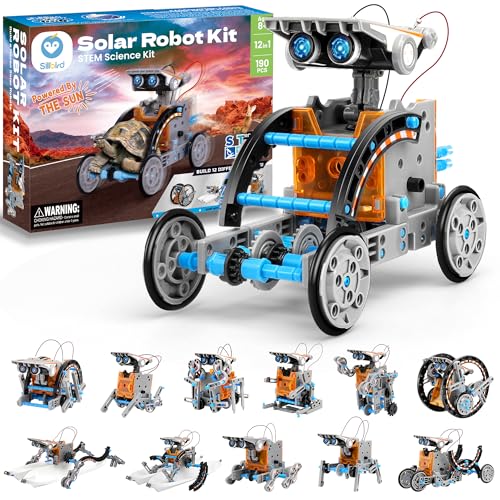
The Sillbird 12‑in‑1 Solar Robot Building Kit turns a sunny day into a hands‑on engineering lab. With 190 precision‑cut pieces, kids can assemble 12 different models—robots, cars, and more—each with its own level of challenge, so the set grows alongside their skills. The upgraded, larger solar panel captures more sunlight, delivering a strong power boost that lets the creations zip across the floor or glide under a simple flashlight. Whether you’re outdoors soaking up real sun or indoors with an artificial light source, the robots stay powered and ready to roll. Clear, step‑by‑step instructions guide young builders to success, encouraging independent play or collaborative family projects. Beyond the fun, the kit introduces renewable‑energy concepts, engineering basics, and problem‑solving techniques, making it a perfect screen‑free gift for birthdays, holidays, or any milestone.
Pros
- STEM‑focused learning – hands‑on building and solar power teach engineering and renewable‑energy principles.
- Scalable difficulty – 12 models range from beginner to advanced, keeping the kit engaging as children grow.
- Versatile power options – works outdoors with sunlight or indoors with a flashlight, ensuring uninterrupted play.
Cons
- Requires adequate light (sunlight or a strong artificial source) for optimal performance; dim indoor lighting may limit robot movement.
- Small parts may be a choking hazard for younger siblings, so supervision is recommended for ages under 8.
2. ELEGOO UNO R3 Robot Car Kit

The ELEGOO UNO R3 Smart Robot Car Kit V4 turns a curious kid into a budding engineer. Designed for ages 8‑16, this all‑in‑one STEM kit blends hands‑on electronics, coding, and robotics into a single, exciting project. The car comes with 24 different modules—including obstacle‑avoidance sensors, line‑tracing, and an infrared remote—so youngsters can experiment with multiple functions and even control the robot from Android or iOS devices. Assembly is straightforward thanks to the redesigned XH2.54 connector ports, which snap together securely and minimise wiring errors. A high‑definition tutorial walks users through every step, providing both the mechanical guide and the complete source code needed to bring the car to life. The sleek, minimalistic packaging makes it an attractive gift for both boys and girls, and the UNO R3 board offers a familiar Arduino‑compatible platform for future upgrades.
Pros
- Comprehensive learning set – combines hardware assembly, sensor integration, and programming in one kit.
- User‑friendly wiring – XH2.54 connectors simplify construction and reduce mistakes for beginners.
- Multi‑platform control – works with phones, tablets, and a traditional remote, expanding play options.
Cons
- Requires basic electronic knowledge; younger users may need adult supervision to get started.
- The large number of modules can be overwhelming for a first‑time builder without guided instruction.
1. Anker Arm Robot Kit

The Robot Arm Kit brings the excitement of robotics straight to the workbench. Inside the box you’ll find a micro‑controller PCB, small DC motors, wires, and a set of precisely‑cut wooden components that snap together without soldering. By wiring the circuit and programming the controller, kids (and adults) can make the arm lift, swivel, and grip—turning a 3‑D puzzle into a hands‑on lesson in electronics, physics, and mechanical engineering. The kit is designed for ages 8 and up, making it a perfect bridge from simple toys to real‑world STEM projects. Just add six AA batteries (not included) and watch the arm come to life. Whether it’s a birthday surprise, an Easter basket stuffer, or a classroom activity, this kit delivers hours of creative problem‑solving and a satisfying sense of accomplishment once the arm is fully assembled and moving.
Pros
- All‑in‑One STEM Experience: Combines circuit building, coding, and wooden construction for a comprehensive learning adventure.
- No Soldering Required: All parts are pre‑drilled and connectorized, keeping the build safe and accessible for younger users.
- Scalable Challenge: Suitable for beginners and can be expanded with additional sensors or programming tasks for older kids and adults.
Cons
- Battery Requirement: Six AA batteries are needed but are not supplied, adding an extra purchase.
- Limited Advanced Features: The basic kit lacks optional accessories (e.g., grippers or extra sensors) that more experienced hobbyists might desire.
Buying Guide
When choosing a STEM building kit for a teen, prioritize age‑appropriate challenges, hands‑on learning value, and long‑term engagement. A good kit balances educational depth with fun, encouraging creativity while building real‑world skills.
- Quality of components: durable, well‑fitted pieces, safe materials, and reliable connections.
- Educational content and features: clear instructions, curriculum alignment, coding or robotics integration, and experiment guides that grow with the teen’s skill level.
- Expandability and versatility: modular design that works with other kits, optional add‑ons, and interchangeable parts for future projects.
- Value for money: a generous part count, depth of projects, reasonable price, and a solid warranty or customer support.
- Community and reviews: active online forums, user feedback, tutorial videos, and a reputable brand reputation that assures quality.
By weighing these factors, you’ll find a kit that keeps teens motivated and learning long after the box is opened. A well‑chosen STEM kit becomes a launchpad for curiosity, problem‑solving, and future tech confidence.
Frequently Asked Questions
What are the top STEM building kits for teens interested in robotics?
Answer:
– LEGO® Mindstorms Robot Inventor – Offers a versatile platform with programmable motors, sensors, and a user‑friendly app that teaches coding in Python and block-based languages.
– Arduino Starter Kit – Ideal for teens who want to dive into electronics and programming; includes a microcontroller, a variety of components, and a project guide that covers 15 hands‑on experiments.
– Sphero SPRK+ – A spherical robot that can be programmed via drag‑and‑drop or JavaScript, perfect for exploring physics, geometry, and coding concepts while encouraging creative problem‑solving.
How do I choose a STEM kit that matches my teen’s skill level?
Answer:
1. Assess prior knowledge – Beginners benefit from kits with step‑by‑step instructions and visual coding (e.g., LEGO® Boost or Sphero SPRK+).
2. Look for scalability – Kits like the Arduino Starter Kit start simple but allow expansion with additional sensors and modules as skills grow.
3. Check the learning curve – Review the included curriculum or online tutorials; kits that provide both block‑based and text‑based programming options let teens progress at their own pace.
4. Consider interests – If your teen loves vehicles, a robotics kit with motors and wheels is ideal; if they’re fascinated by gadgets, an electronics‑focused kit will keep them engaged.
Are there affordable STEM building kits that still offer a rich learning experience?
Answer:
Yes! Here are three budget‑friendly options that don’t compromise on educational value:
- Kano Computer Kit – Priced around $150, it lets teens build a Raspberry Pi‑based computer and learn coding through games and challenges.
- Snap Circuits Extreme – A $50‑$70 kit that introduces circuitry concepts with snap‑together components, perfect for hands‑on experimentation without soldering.
- Thames & Kosmos Engineering Kit – For roughly $60, this kit focuses on mechanical engineering principles, providing gears, pulleys, and structural parts to build functional machines.
These kits provide solid foundations in STEM while staying within a reasonable price range.
Conclusion
Choosing the right STEM building kit empowers teens to explore curiosity, develop problem‑solving confidence, and translate abstract concepts into tangible achievements. The most effective kits balance challenge with accessibility, encouraging hands‑on experimentation while offering clear guidance and room for creative expansion. Prioritizing quality components, modular designs, and supportive online communities ensures that learning remains engaging and sustainable. By aligning a kit’s focus—whether robotics, electronics, or engineering—with a teen’s interests and skill level, parents and educators can foster lasting enthusiasm for science and technology, turning playtime into a springboard for future innovation.

